
The She-ief Medical Officer: Powerful, Targeted, and Still Misunderstood
A Klick Health Primary Study on How Women Connect with Healthcare Brands
Authored by Christina Mullen, Meredydd Hardie
What you’ll learn:
Women drive 80% of family healthcare decisions and arrive at appointments more prepared than ever, yet many brands still misunderstand what they need and underestimate their unmet need for genuine understanding, despite being one of healthcare marketing’s most heavily targeted audiences.
Brand trust is a clinical variable: 84% of women say they are most motivated to start treatment from a company that demonstrates a strong understanding of women’s health, outranking clinical legacy, peer use, and physician endorsement.
A generational values shift appears to be reshaping healthcare loyalty. Younger women are watching how brands behave when supporting women gets complicated, and the brands that adapt now may be the ones that define the next decade of women’s health.
Walking into a doctor’s appointment is different for women. By the time we are sitting on the table, we have already been on Reddit scanning side effects and efficacy. We read the clinical summary, had multiple group texts with our squad, and used AI to spin up a full report on symptoms and treatment.
We prepare. And we don’t want a monologue. We want a conversation.
The data confirms it. Here at Klick, Meredydd Hardie and I teamed up to conduct companion studies with both consumers and HCPs, focused on how women manage our health and how we choose the healthcare brands that help us.
In a survey of 248 U.S. women aged 18–65 fielded in December 2025, 89% of women said they want to understand all of their options before acting on a healthcare decision. Doctors still remain a top influence (72%), but their own research runs a close second at 69%.
We see ourselves as more co-investigators than passive recipients of medical advice, and that’s true of most women engaging with healthcare today. The data shows that directly. But beyond that, what it suggests is even sharper: the real competition for a healthcare brand isn’t happening in an ad or on a shelf. It’s happening earlier, inside the research we women are already doing on our own—and a brand either holds up under that scrutiny, or it doesn’t.
And it’s not just our findings in the consumer-focused study. HCPs confirm this from the other side of the exam room door. A Klick Health primary research study conducted in December 2025 (surveying 157 healthcare providers across the United States, United Kingdom, Canada, Germany, Spain, Sweden, Switzerland, and Denmark) revealed a critical insight for the industry: women are among its most heavily targeted audiences, and still one of its most misread.
Our study results point to a consistent pattern: brands that understand how we prepare, how we research, and how we live within our conditions are the ones best positioned to earn our business and our trust.
Healthier Women, Healthier for All
Read NowDoing it all but last in line
Most of us know the numbers in healthcare:
Women make approximately 80% of all family healthcare decisions in the United States, according to the U.S. Department of Labor.
We make up more than two-thirds of pharmacy shoppers.
We schedule appointments, research providers, and coordinate care, often for everyone in our household...except ourselves.
Roughly 78% of women report putting off their own healthcare because they’re so busy managing everyone else’s.
The consumer data makes this self-sacrifice explicit, especially among mothers:
87% act more quickly on healthcare decisions for their child than for themselves.
85% push harder for answers when the decision affects their child.
80% are more willing to absorb inconvenience or cost for their child.
75% research treatment options more thoroughly for their child than for themselves.
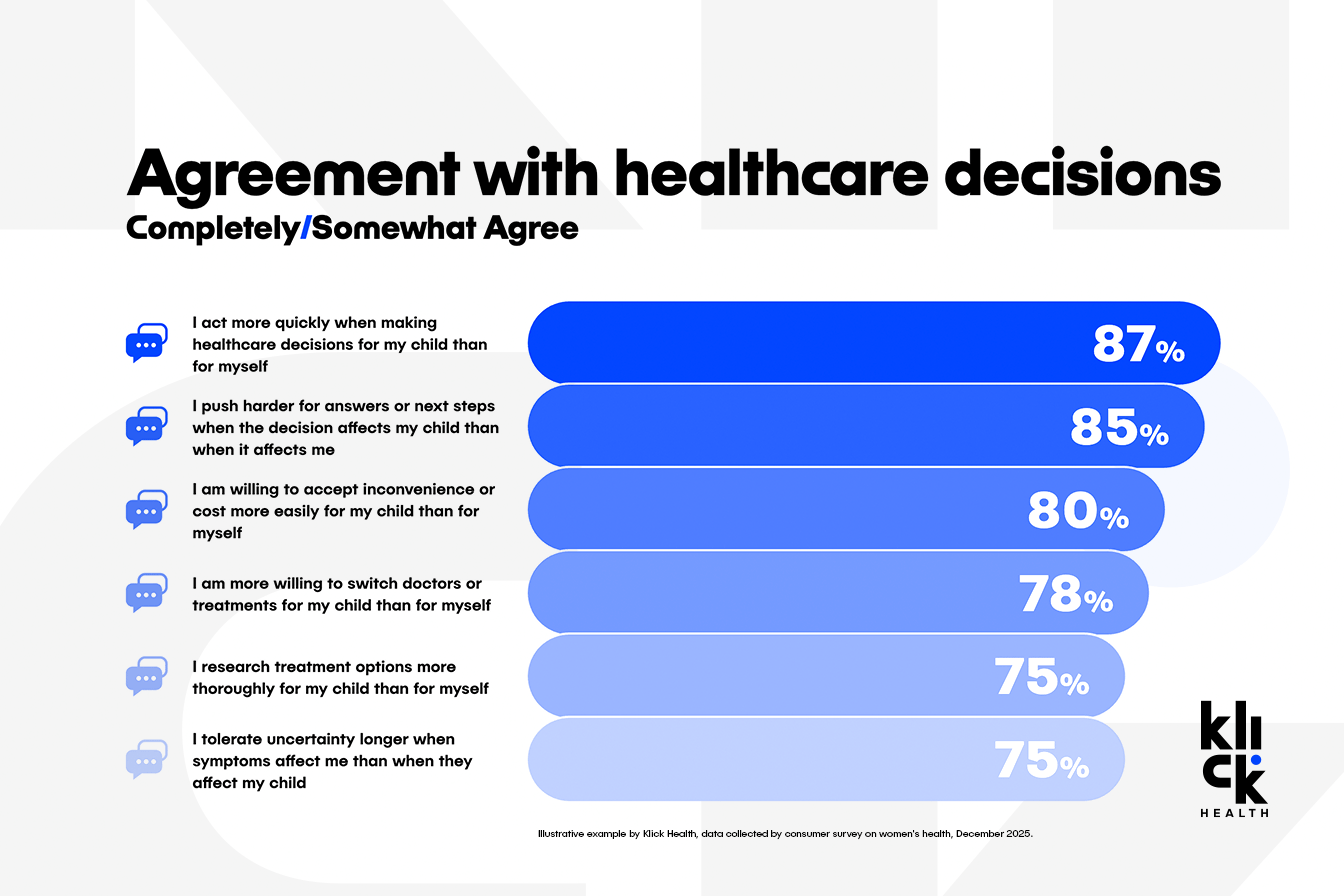
When asked why, consumer survey respondents didn't hold back. They are perfectly self-aware about this.
“My health concerns always feel less urgent than anything concerning my child.”
“I might put off going to the doctor for months for myself, but I will get them to the doctor immediately.”
“I would pay any cost and do anything to keep my kid healthy but I neglect my own health due to cost.”
“I just usually put myself last.”
This data makes clear that one of the most influential purchasing and decision-making cohorts in all of medicine is also one of the most underserved, in part because she deprioritizes herself. Only a small fraction of mothers in the survey justify self-care only in instrumental terms: “If I’m not well, then there is nobody else to take care of my child.” Her health, in her own framing, is a means to an end—not an end in itself.
These findings point to a real opening for brands: not just messaging to her, but making the case for why her own health is worth researching in the first place. Whether that translates into brand growth is a question worth testing, not assuming.

Women in the exam room: Craving conversation
Across all countries surveyed, HCPs describe a consistent and striking pattern: conversations with female patients are longer, more detailed, more emotionally complex, and more future-oriented than with male patients.
Women arrive prepared with lists, questions, prior research, and concerns that span not just the presenting issue but its ripple effects across their daily lives.
“Conversations with women are longer,” one HCP noted. “They are more worried about side effects and ask in depth.” Another: “Women often come more educated about their concerns. It’s likely they’re ignored and dismissed more frequently and feel like they have to advocate for themselves.”
Men, by contrast, are described as transactional and outcome-focused. “Men just want a quick answer. They do not care so much.” The asymmetry is also a paradox: female patients bring more engagement, more preparation, more emotional investment, but have been historically less institutionally respected.
“Women spend more time thinking about these issues. They talk to each other. They research. They come in ready. They just want someone to meet them there.” –HCP respondent
This suggests brands have a role to play before the appointment even happens—not by inserting themselves into the exam room, but by giving women better material to prepare with. Whether that builds loyalty will vary brand by brand, but the HCPs describing this pattern are effectively describing an audience already doing a brand’s homework for it.
Women’s health defined: Expanding beyond the bikini

The consumer data maps to a shifting landscape that is moving to better serve us. Women’s health history is dominated by menstrual cycle concerns (55%) and hormonal symptoms (52%) (e.g., mood, sleep, weight). Mental/emotional health challenges follow closely at 47%. These “invisible” or lifestyle-disrupting symptoms are more prevalent than diagnosed conditions like cardiovascular concerns (25%) or bone health (24%). The historical framing of women’s health as primarily gynecological isn’t being replaced so much as it’s expanding sideways.
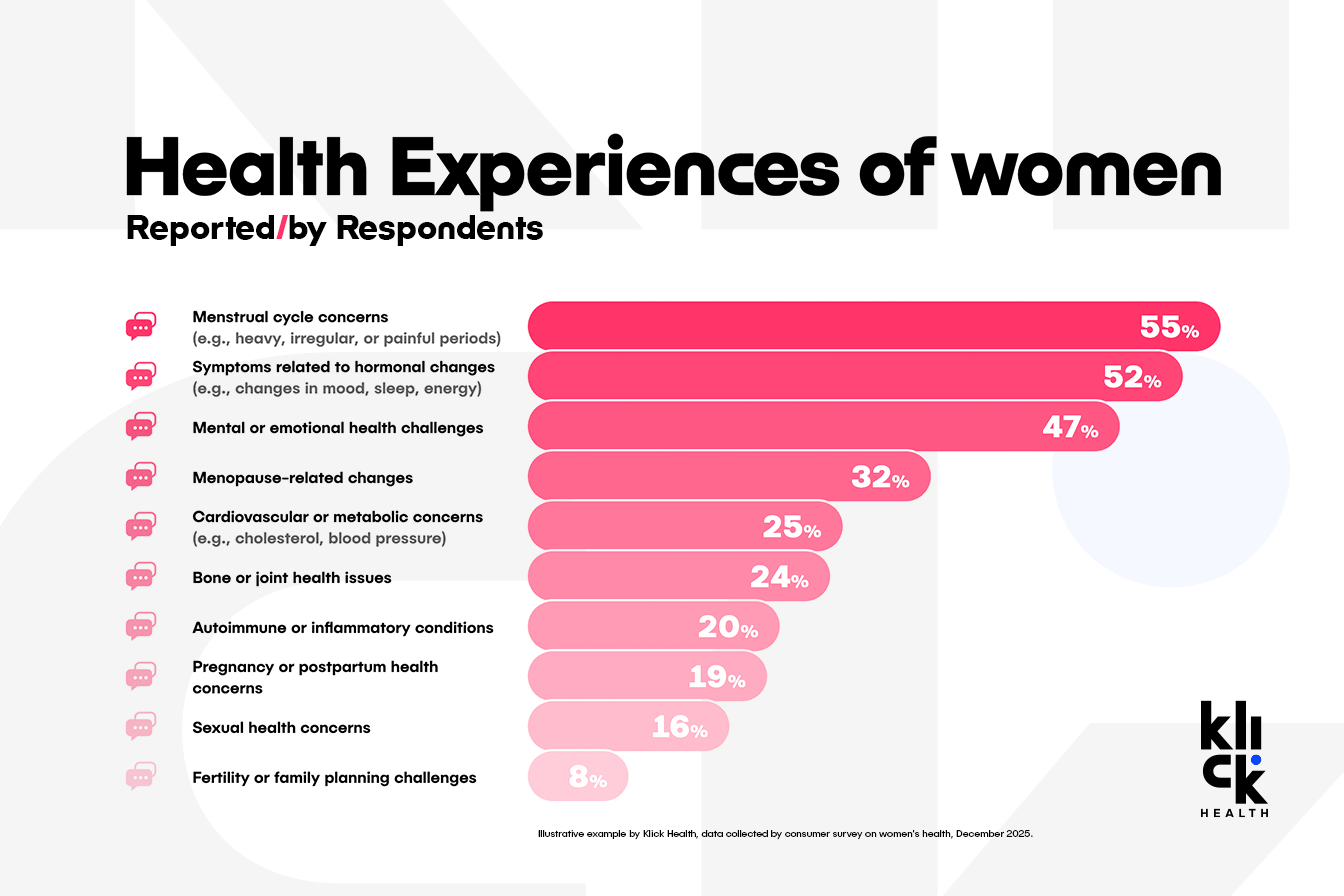
Women express this in their own words:
"Women’s health is not just about gynecological care but also a broader range of health issues, including mental health."
'It means whole body—mind, body, spirit—emotional, mental, incorporates medicines but also exercise, nutrition, and sleep."
"Women’s health isn’t a one-size-fits-all. Each person is different."
This suggests something straightforward to state and harder to act on: women are not waiting to be educated; we are arriving educated, and we define our health more expansively than the healthcare system typically meets.
That’s the real shape of the competition. Brands aren’t just competing for attention, they’re competing to survive the research a woman is already conducting—checking a brand’s message against what her doctor says, what her friend experienced, and what she found on her own at 11 p.m. on her phone. The brands that win won’t be the loudest. They’ll be the ones that hold up under that scrutiny.
Brand trust drives clinical outcomes

Perhaps one of the most insightful findings in the HCP study is how directly clinicians connect brand trust to clinical outcomes. This is not about preference or loyalty programs but whether women stay on treatment at all.
75% of surveyed HCPs say brand trust shapes adherence.
Three-quarters say it shapes initiation.
And yet, only 18% of HCPs associate leading pharmaceutical brands with “understanding women’s lived realities,” and just 15% describe them as “long-term, not opportunistic.”
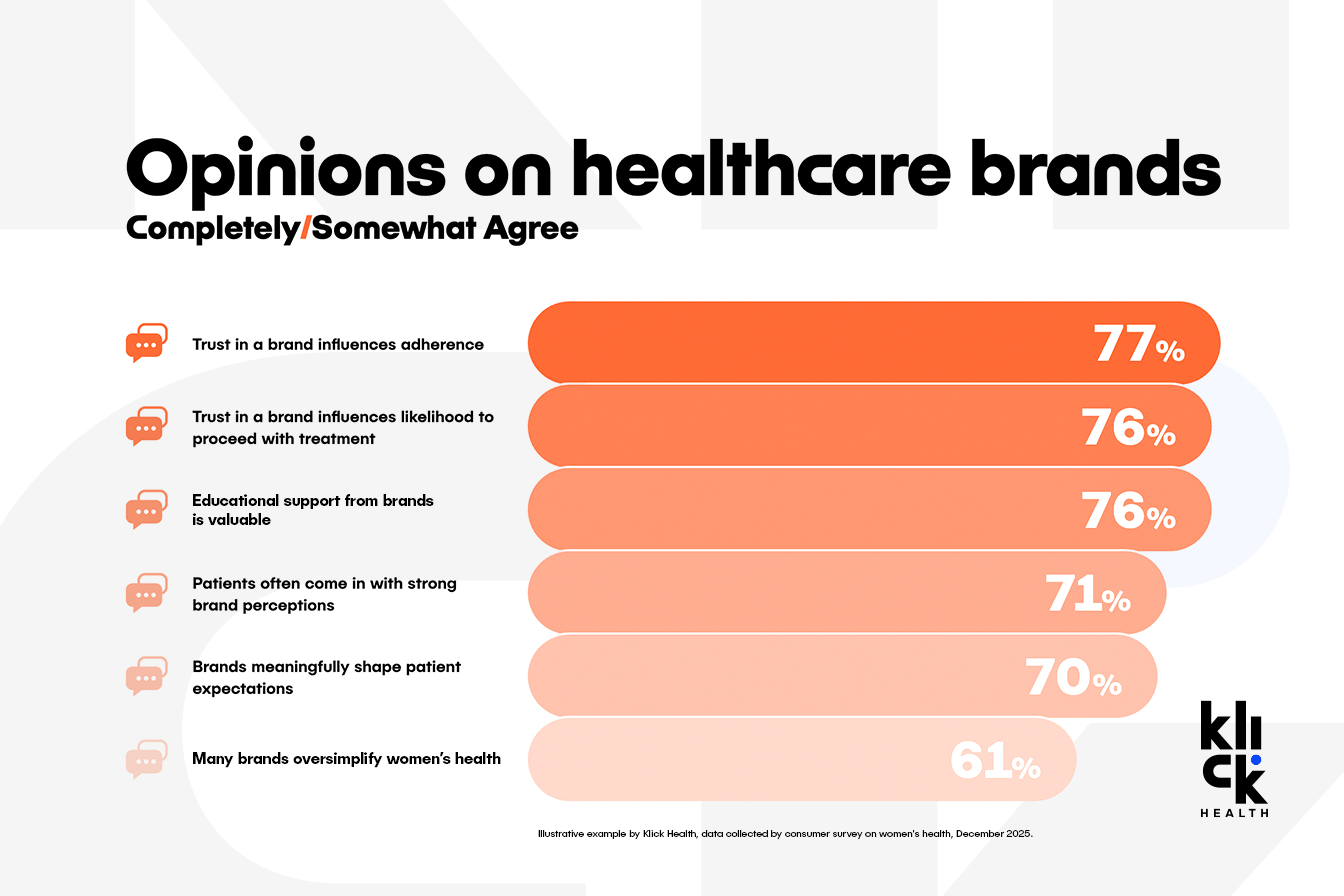
This is the trust gap made visible in the data: not a failure to reach women, since pharma already spends heavily trying, but a failure to survive contact with them once they start looking closely.
And important side note: according to previously released data from the AAMC, in 2023–24 women accounted for 54.6% of medical school students, after having become a majority for the first time in 2019–20. So not only are HCPs citing this difference, but more HCPs themselves are women, so connecting with them differently is critical for long term success.
Our consumer study reveals what this trust deficit costs and how brands can close the gap. When women were asked what would most motivate them to start a prescribed treatment, with cost, efficacy, and side effects held equal, the top answer is all about understanding: a medication from a company that “demonstrates a strong understanding of women’s health” (84%).
This outranked “a company with a long history in this disease area” (79%), “a medication many women like me are already using” (79%), and even “a company highly trusted by doctors” (76%).
When all clinical variables are equal, what motivates women most is the sense that the company behind the medicine actually understands her. The data suggests that’s not a soft metric—it functions as a conversion driver.
84% of women are most motivated to start treatment from a company that “demonstrates a strong understanding of women’s health”—outranking clinical legacy, peer use, and physician trust.
Brand loyalty patterns add texture to this. 85% of women in the consumer survey say they tend to stick with a brand once they find one that works—a strong retention signal. But 77% say they would consider switching if a new brand better reflected their current life stage or needs. That combination suggests loyalty here is sticky but not unconditional: it looks like it’s earned by continued relevance, not just past performance.
Younger women go further still. Among 18–34-year-olds, 73% say they notice when pharmaceutical brands meaningfully support women as opposed to just market to them. Among women 55–64, that number falls to 29%. The gap suggests younger women are applying a stricter test to brand behavior than their older counterparts.
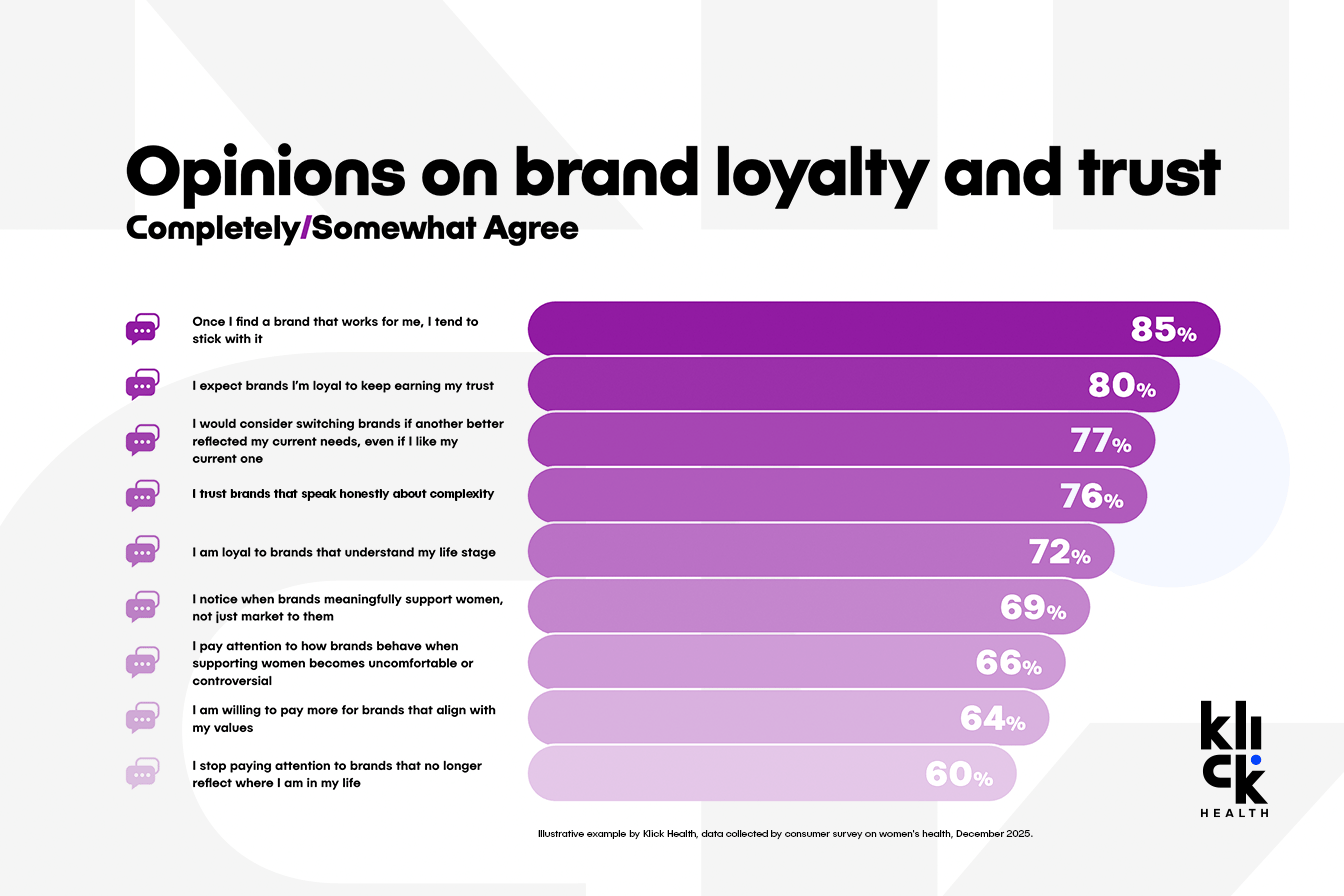
That gap points to a generational shift underway. The next decade of healthcare consumers appears likely to evaluate brands through a values filter their older counterparts largely didn’t use. Brands that adapt to that filter may be better positioned for what comes next; those that don’t will be judged by an audience that’s already watching closely.
Brand leadership through deep understanding
The winning brand does not just know the science. It understands that women evaluating treatments are also managing fear, navigating conflicting information, and deciding whether to trust this company with our bodies and our stories.
The data points to brands that combine clinical rigor with genuine patient empathy as the ones best positioned to lead the next chapter of women’s health: building educational platforms rather than just promotional campaigns, and treating conditions as life stories and experiences rather than symptom checklists. That matters in front of a generation increasingly watching how brands behave when supporting women becomes uncomfortable or controversial—66% of women 18–44 say they pay attention to exactly that.
Research, rigor, and relevance: The real competition

Somewhere in a waiting room right now, a woman is on her phone. She’s looked up the drug name, read the reviews, scanned the forums, and formed an opinion. When she walks into the exam room, she will ask her doctor what they think, and her doctor’s answer will be shaped, in part, by what that brand has built in the minds of clinicians.
We come prepared. That part isn’t new. What the data adds is a sharper picture of what “prepared” is actually competing against: not other messages, but the research a woman has already done herself. The real question for any brand isn’t whether she’ll find you, which is obviously critical, it’s also how you stand up to what she perceives and what she has learned. And if you really “get” her life.
Women control the majority of healthcare decisions. They engage more deeply, research more thoroughly, and hold brands to a higher standard than the industry has generally assumed. Yet they self-sacrifice for everyone around them, and by their own account, they notice—even when they don’t act on it—when a brand finally sees them back.
In a market where 61% of clinicians say brands are oversimplifying women’s health and 38% of women consumers can’t name a single company they’d call a leader, the gap between how women already research their health and how brands currently show up in that research is wide. Closing that gap, not filling empty space, is the opportunity: earning women’s trust and loyalty by becoming the brand that holds up when she checks.
Disclaimer
While the data in this article is pulled from reports focused on those assigned female at birth, we recognize that inequities in “women’s health” impact a wider spectrum of individuals, including transgender women, non-binary individuals, and others.
Methodology
HCP Study: Klick Health commissioned a primary research study fielded on Sermo in December 2025. A total of 157 healthcare providers were surveyed across 8 countries: United States (n=53), Spain (n=43), United Kingdom (n=22), Germany (n=16), Canada (n=11), Switzerland (n=5), Denmark (n=4), and Sweden (n=3). Respondents included Primary Care Physicians (n=111), Gynecologists (n=40), and Pharmacists (n=6). All respondents currently treat women’s health conditions.
Consumer Study: A companion Klick Health consumer survey was fielded on Sago Methodify in December 2025. A total of 248 U.S. women aged 18–65 (with emphasis on 25–54) were surveyed in English. The study explored brand attitudes, healthcare decision-making behaviors, treatment barriers, and perceptions of leadership in women’s health. Supplementary statistics sourced from the U.S. Department of Labor, AARP, Grand View Research, Edelman Trust Barometer, and other cited third-party sources.



Ready to Drive Life Sciences Forward?
Experience the transformative power of Klick Health, where deep industry expertise meets cutting-edge AI-driven wisdom.
As your trusted partners in life sciences commercialization, we combine a storied history in healthcare with the latest technologies to elevate every facet of your omnichannel strategy. From crafting engaging narratives to enabling data-driven decision-making, our integrated capabilities ensure you lead the way in transforming patient outcomes through digital health innovation.
Let’s create something transformative together.