
The Launch Foundation: Where Every Trajectory Is Set
Defining the Launch Archetype
Authored by Andrew Smith, PhD; Jackie Piccolo, MBA; Brian Fox
What you’ll learn
Launch trajectory is shaped early, not just at commercialization. Development, scientific, and access decisions made during the clinical stage can materially define long-term success.
Effective launch planning starts with diagnosing the conversation, the asset, and the market to determine what matters before and during launch.
Most launches fall into five archetypes, each requiring distinct priorities and cross-functional decisions rather than a one-size-fits-all playbook.

The center of gravity in biopharma is shifting toward first-time launchers, creating unprecedented opportunities for emerging organizations. A significant share of future blockbusters’ assets (projected to exceed $1 billion in peak annual sales) resides in the portfolios of first-time and recent launchers, positioning emerging biotechs as holders of disproportionate future industry value.[1]
Today’s landscape is defined by compressed timelines, unprecedented competition, and heightened scrutiny from investors, regulators, HCPs, and patients. In that context, capturing a brand’s full potential requires more than aspiration. Launch trajectories now determine long-term performance: Fewer than 30% of products can recover from a poor launch and show meaningful recovery within 18–24 months.[2,3] There is little margin for error and even less room to treat launch as a single moment in time.
For clinical-stage companies and biotechs preparing for a first-asset launch, the pressure is immediate, but the challenge is rarely a lack of understanding of what needs to be done. More often, teams are operating with extremely limited bandwidth. The commercial team is frequently a single-digit one tasked with coordinating a wide range of activities while also responding to the most urgent demands of the moment.
Preparing for launch is inherently complex, cross-functional, and time-bound, often requiring two to three years of integrated planning across medical, access, commercial, corporate, and brand functions. Yet those capabilities typically come on board at different points in time, forcing teams to make trade-offs about what can realistically be addressed and when. As a result, teams are often forced to play catch-up, making up for lost time on critical activities that were deferred out of necessity but ultimately still need to be completed. In this environment, even strong leadership teams can struggle to deliver truly distinctive outcomes—not because they lack intent or capability, but because sequencing, integration, and focus are constrained from the start.
In response, small teams often feel pressure to do everything at once. That’s overwhelming, unachievable, and likely to be ineffective. Instead, successful organizations focus on a distinct, narrow set of actions customized to the unique context of their brand launch. They prioritize the activities that deliver the greatest leverage for the resources available, intentionally lean into cross-functional intersection points where progress in one area advances multiple objectives, and ensure the fundamentals are covered without allowing them to dominate time, attention, or decision-making.

The Launch Paradox
The paradox of launch is this: As launch nears, complexity increases and focus becomes more critical, yet harder to achieve. The most effective launch strategies resist the pull of activity for activity’s sake. Instead, they begin by grounding every decision in a clear understanding of the asset and its context.
We have seen that clarity consistently emerges from understanding three foundational elements: the conversation, the asset, and the market.
The Conversation
What is the baseline level of organic, ongoing engagement around the condition among HCPs, patients, and other key stakeholders across relevant channels? How well and how broadly recognized is the unmet need? What is the prevailing sentiment and discussion around competitive products already on the market? Which competitors are shaping perceptions, expectations, and standards of care? Is demand already building, or does the market need to be educated before it can recognize the opportunity?
Answering these questions is critical to setting the brand’s communication objectives, informing whether the strategy should prioritize demand acceleration versus foundational education, and identifying existing beliefs and biases that may need to be leveraged or overcome, particularly among HCPs and payers.
The Asset
How clinically differentiated is the asset relative to existing and emerging competitors in terms of efficacy, safety, durability, and evidence base? Is the new product curative, disease-modifying, or progression-controlling, or does it simply treat the symptoms? Does the science clearly outperform existing options, or does its value depend on reframing how the disease is understood or treated? How complex is the clinical story to communicate? Will the mechanism of action be easily understood and trusted, or is it highly novel? How does the asset’s clinical narrative and evidentiary profile compare to others in the category?
This is generally the topic area best known by teams, but answering these questions systematically and taking the perspective of general HCPs and payers (rather than relying solely on the views of the R&D team and/or KOLs) is important to developing a perspective for how the asset will actually be seen by the market (versus how you think the asset should be seen).
The Market
What barriers or enablers will determine whether patients can realistically access and use the product? How will pricing, reimbursement, payer management, and channel dynamics shape formulary positioning and uptake? What level of utilization management (e.g., step edits, prior authorizations) should be anticipated? What operational or infrastructure requirements (e.g., supply chain, site of care, administration, monitoring, HUB services, etc.) could accelerate or constrain adoption? Ultimately, the market lens is not just about anticipating access mechanics, but about identifying the population-level decision-makers, from payers to health systems, whose choices will shape the opportunity.
While the questions in each of these categories are simple, together they create a critical picture of the headwinds and tailwinds you are likely to face during launch; they reveal not just what a product is but what kind of launch it requires.

From Insight to Archetype
When viewed through these three lenses, patterns begin to emerge. Some launches must create an entirely new market, while others must win share in an overcrowded category. Some succeed by shifting treatment paradigms, while others find success through precision, access, or experience rather than scientific novelty alone.
These patterns are not abstract, they cluster into distinct launch archetypes. The danger is assuming a one-size-fits-all launch playbook. The opportunity lies in identifying your archetype early and using it to deliberately guide prioritization, sequencing, and investment. The key is to ensure each decision aligns with and reinforces your launch trajectory.
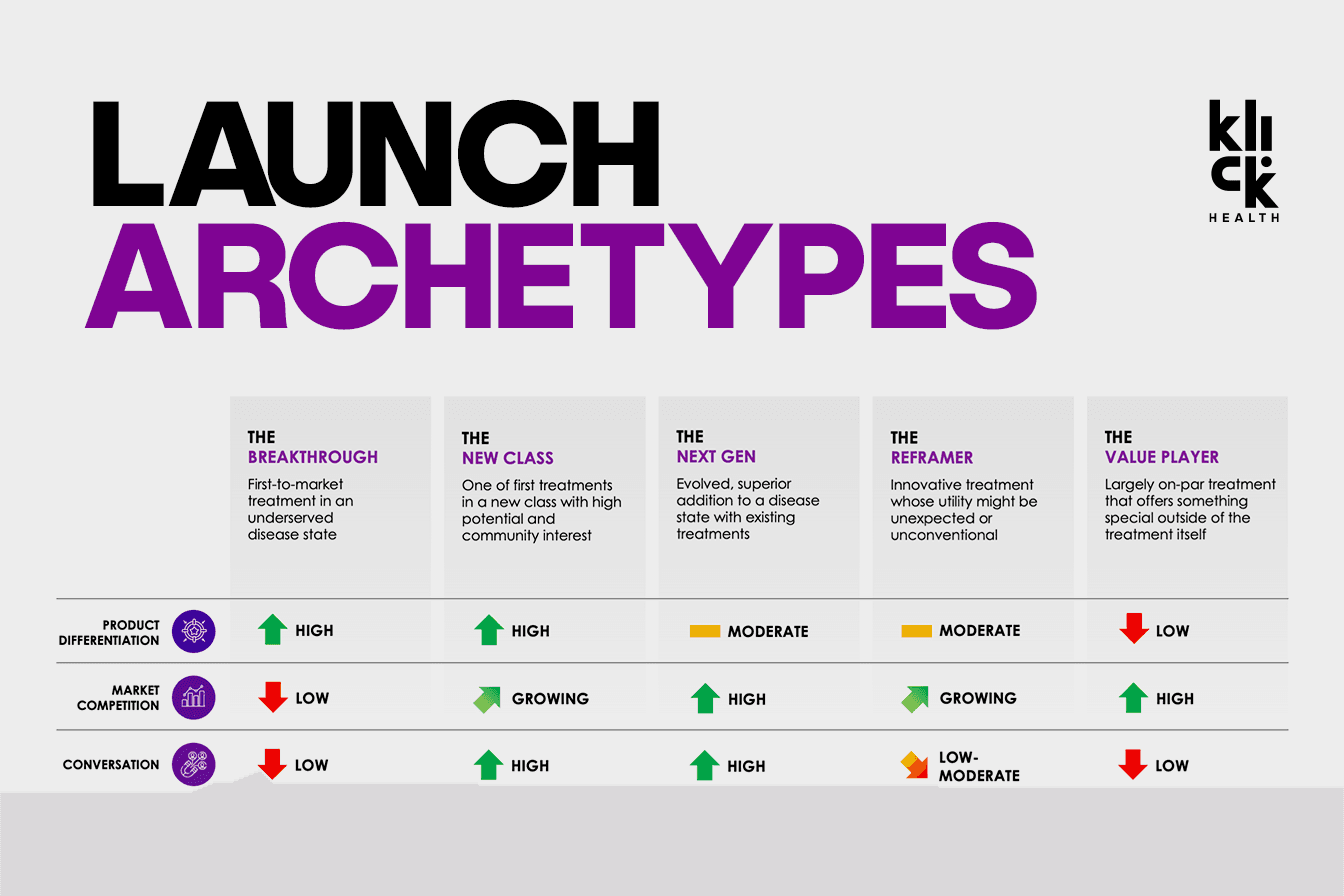
While no two launches are identical, most fall into one of five recurring launch archetypes or, very occasionally, a hybrid of two archetypes. Each archetype reflects a distinct combination of conversation intensity, asset differentiation, and market dynamics.
That archetype becomes the foundation for everything that follows: it shapes where to lead with medical versus brand; how aggressively to push demand versus education; and when to focus on access, advocacy, or corporate reputation. Most importantly, it ensures that early decisions reinforce each other rather than compete for attention.

Meet the Five Primary Launch Archetypes
1. The Breakthrough
VIEW DETAILS
2. The New Class
VIEW DETAILS
3. The Next Gen
VIEW DETAILS
4. The Reframer
VIEW DETAILS
5. The Value Player
VIEW DETAILS
Next Steps: Identification Is Just the Beginning
Each of these five launch archetypes reflects a fundamentally different starting point. A different kind of uncertainty. A different source of risk.
What they share is this: None of them can be launched well using the same playbook. Each archetype, therefore, demands a distinct approach to launch planning—different priorities, different activities, and a different sequencing of decisions throughout the three years leading up to launch. Some decisions must be made early for a given archetype while those same decisions can be delayed in another archetype. This tailored planning model enables teams with limited bandwidth and resources to focus their efforts where they matter most, at the right moments in the pre-launch timeline, driving greater efficiency and effectiveness.
In the second article of this three-part series, we will demonstrate how each archetype translates into a distinct launch strategy: one that helps teams focus on the right decisions at the right time, align cross-functional efforts, and design execution plans that reflect the true launch reality rather than an idealized one.
References
Klick Health is the world’s largest independent commercialization partner for life sciences and a leading full-service pharma marketing partner, serving as agency of record for leading pharma, biotech, and healthcare brands. Klick’s specialized offerings are rooted in deep medical and scientific understanding, including market insights, award-winning creative, and proprietary AI and data models to craft impactful brand narratives and seamless customer journeys. Backed by nearly 250 medical experts and advanced healthcare analytics, Klick delivers integrated marketing strategy and communications, from new product launch strategy to MLR review with real-world evidence, helping brands thrive in today’s complex healthcare landscape. Learn more at Klick.com.
Authors

Andrew Smith, PhD
SVP, Consulting

Jackie Piccolo, MBA
Senior Vice President, Strategy

Brian Fox
President, Chief Growth Officer



Ready to Drive Life Sciences Forward?
Experience the transformative power of Klick Health, where deep industry expertise meets cutting-edge AI-driven wisdom.
As your trusted partners in life sciences commercialization, we combine a storied history in healthcare with the latest technologies to elevate every facet of your omnichannel strategy. From crafting engaging narratives to enabling data-driven decision-making, our integrated capabilities ensure you lead the way in transforming patient outcomes through digital health innovation.
Let’s create something transformative together.