
What you’ll learn:
Regulators, payers, clinicians, and patients each judge a therapy’s value differently, and planning evidence generation one function at a time often leaves gaps when approval, reimbursement, and prescribing decisions are made.
Integrated evidence generation planning (IEGP) replaces sequential handoffs among R&D, medical affairs, market access, and affiliates with a single plan centered on the decisions each stakeholder must make.
No two IEGPs look completely alike; however, organizing evidence around decisions, not departments, should remain the core discipline when planning evidence generation.
Every Stakeholder Wants Something Different
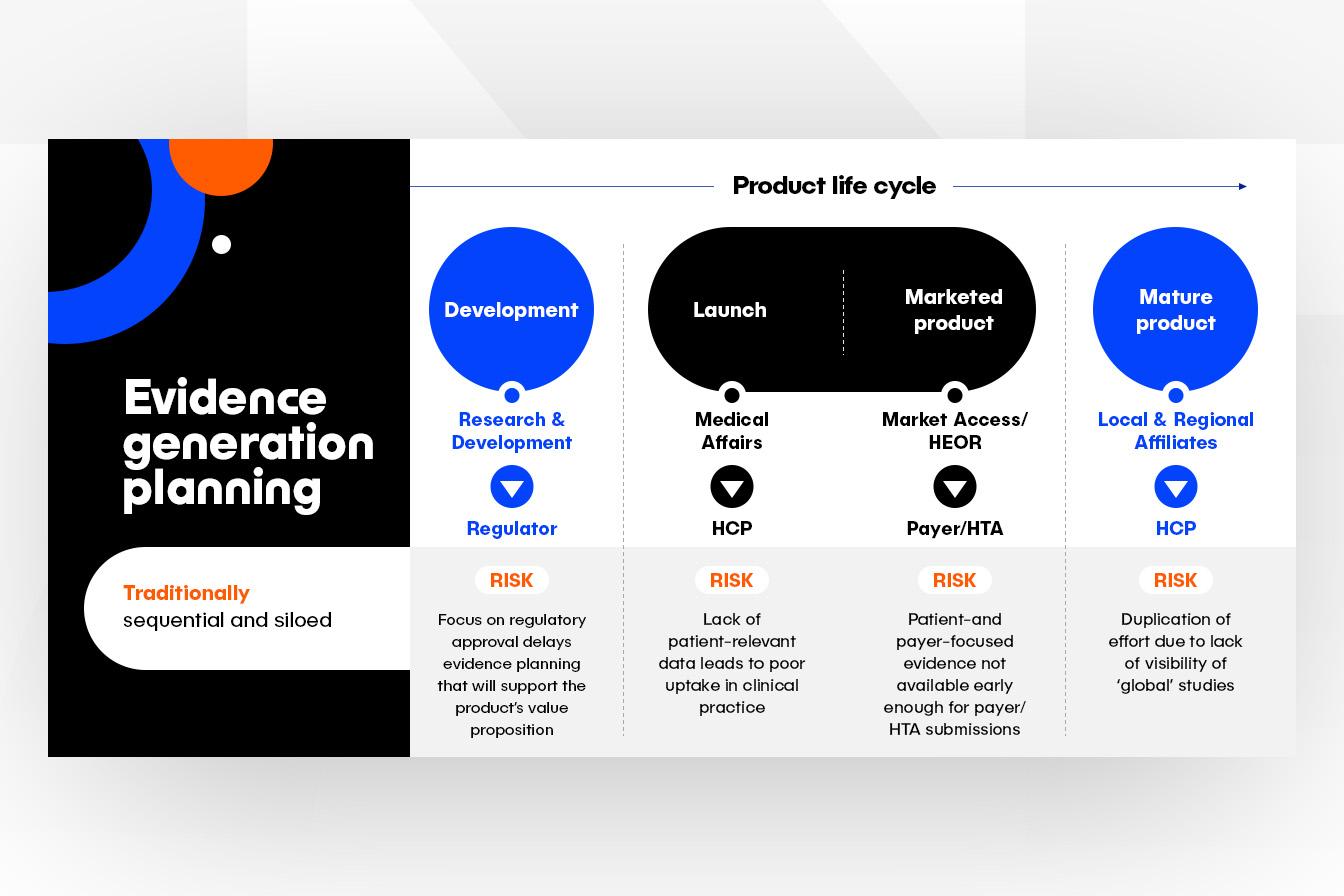
Ask five healthcare decision-makers what “proving a therapy’s value” means, and you’ll get five different answers. To a regulator, it’s safety and efficacy data. To a payer or HTA body, it’s cost-effectiveness and comparative outcomes. To a clinician, it’s real-world applicability. For a patient, it’s whether the treatment improves their disease state or quality of life. Those answers also shift by geography. Historically, companies have tried to answer these questions one at a time, treating evidence generation as a baton passed from R&D to medical affairs to market access, with each function, and each market, working from its own priorities.

The Cost of Planning in Sequence
Relay-style planning carries risk for every stakeholder. A regulatory-first focus can delay evidence for a product’s broader value. Payers and HTA bodies can receive comparative data too late. Missing patient-relevant data can slow uptake in clinical practice and delay patient access to a treatment already on the market. And when global studies aren’t visible locally, teams duplicate work rather than build on them.
How an IEGP Works
Integrated evidence generation planning, or IEGP, is the response to that problem. Rather than organizing evidence generation around functional handoffs, an IEGP is a single, decision-focused plan that brings medical affairs, R&D, market access, and HEOR, commercial, and regional affiliates into the same process, from early development through to the mature-product stage. It identifies what regulators, payers, clinicians, and patients each need to decide, whether to approve, reimburse, prescribe, or take a therapy, and maps and tracks the evidence each of those decisions needs.

The Launch Foundation: Where Every Trajectory Is Set
Read NowFlexible by Design
A good IEGP evolves well past its first draft. Teams revisit and refresh it as new data emerge, stakeholder needs shift, and a product moves through its life cycle. Because of that, an IEGP for an early-phase rare disease asset can look very different from one built for a mature product spanning 10 indications and multiple markets. What doesn’t change is the underlying discipline, organizing evidence around decisions, not departments.

From Delivered Studies to Patient Outcomes
The impact is felt well beyond a tidier internal process, though the industry is still developing ways to measure how well an IEGP drives evidence-based decisions and demonstrates value. Companies that implement one often report reaching consensus more quickly on which studies to prioritize and reducing effort across regions. Rather than counting activity alone, the more meaningful measure is whether the resulting evidence changed a decision and, ultimately, improved patient outcomes.

Read the Full Research
Two new articles in Pharmaceutical Medicine take a closer look at how medical affairs can lead an IEGP. The first explains why medical affairs is well-placed for this role and why it depends on close cross-functional collaboration. The second looks inside medical affairs itself, at how subfunctions, including medical strategy, evidence generation and HEOR, field medical, and medical communications each contribute, and how the impact of an IEGP should be measured.
Read the first article: https://link.springer.com/article/10.1007/s40290-026-00620-2.
Read the second article: https://link.springer.com/article/10.1007/s40290-026-00625-x.
About Klick Health
Klick Health is the world’s largest independent commercialization partner for life sciences companies. Together with Oxford PharmaGenesis, the agency helps life sciences brands achieve their full potential with best-in-class marketing and advertising, media strategy and purchasing, medical affairs, medical publications and medical communications, value and market access services, real world evidence support, as well as technology and analytics consulting from clinical development through Loss of Exclusivity (LOE). Established in 1997, Klick Health (including Oxford PharmaGenesis, Klick Katalyst, and btwelve) has offices in Toronto, Cambridge, Cardiff, London, Melbourne, New York, Oxford, Philadelphia, São Paulo, Saratoga Springs, and Singapore.




Ready to Drive Life Sciences Forward?
Experience the transformative power of Klick Health, where deep industry expertise meets cutting-edge AI-driven wisdom.
As your trusted partners in life sciences commercialization, we combine a storied history in healthcare with the latest technologies to elevate every facet of your omnichannel strategy. From crafting engaging narratives to enabling data-driven decision-making, our integrated capabilities ensure you lead the way in transforming patient outcomes through digital health innovation.
Let’s create something transformative together.