
Bridging the “Felt Benefit Gap”
How to Drive Initiation, Adherence, and Persistence When Patients Can’t Feel the Benefit of a Therapy
Authored by Andras Varadi; Dane Lund, PhD; Jorge Durand, PhD
What you’ll learn
The “felt benefit gap” is the disconnect between clinical impact and the patient’s lived experience, especially in chronic and “silent” conditions where risk or progression accumulates in the background.
When therapies with demonstrated clinical benefits deliver little patient-felt improvement, adoption becomes challenging, leading to low initiation, inconsistent adherence, and early discontinuation, ultimately putting patients at significant risk.
Marketers can help close this gap and sustain persistence by building a “felt benefit narrative” and tactics that make clinical benefits feel personally meaningful and attributable, so staying on therapy feels like a win, by amplifying social proof.

In a marketplace captivated by visible transformation, therapies that work quietly in the background face an uphill battle for patient commitment. Because human behavior is wired to respond to immediate feedback, one of the major challenges we face as pharma marketers is bridging the gap between objective disease control and a patient’s subjective experience.
Healthcare providers, patients, and marketers all struggle when therapies deliver clinically meaningful, even practice-changing, outcomes in trials and real-world use, yet don’t feel effective because their benefits are imperceptible to many patients. As GLP-1s drive dramatic weight loss and dermatologic therapies clear skin after only a few doses, medicines focused on preventing negative clinical events must compete with treatments that offer immediate, tangible benefits.

A Familiar Patient Experience
Let’s take the example of a patient who was diagnosed with a rheumatological condition a few years ago and had been on targeted therapy for almost four months. The patient hadn’t consistently felt improvements in pain and fatigue, yet the treatment was controlling disease activity, with imaging and biomarkers trending in the right direction. This is a typical case in which a therapy is clinically effective but does not fully address the lived experience of the disease.
When the felt benefit (what a patient can identify as improved well-being) is minimal while clinical benefit (e.g., improved biomarkers and/or imaging, reduced risk, delayed progression) remains invisible, patients must accept effort (cost and time), inconvenience, and possible side effects without the reinforcement of symptom relief or obvious disease improvement. This impacts initiation and lowers adherence and persistence.
The gap between clinical benefit and felt benefit can cut uptake, adherence, and persistence short

The “felt benefit gap” is most evident in asymptomatic risk conditions, where the problem is practically invisible until a major event occurs. Patients with elevated cholesterol or low bone mass may feel normal, so treatment can seem optional, especially when the payoff is framed as statistical risk reduction. Cost can further amplify these perceptions. When patients are paying significantly out-of-pocket for a therapy they can’t feel, the medication may register as a questionable value or even a waste, increasing the temptation to delay, skip doses, or switch to alternative options, including generics that feel easier to justify.
Brands in these therapeutic areas must set clear treatment expectations with transparency within optimal health literacy parameters and create salience and reassurance, otherwise headwinds prevail.
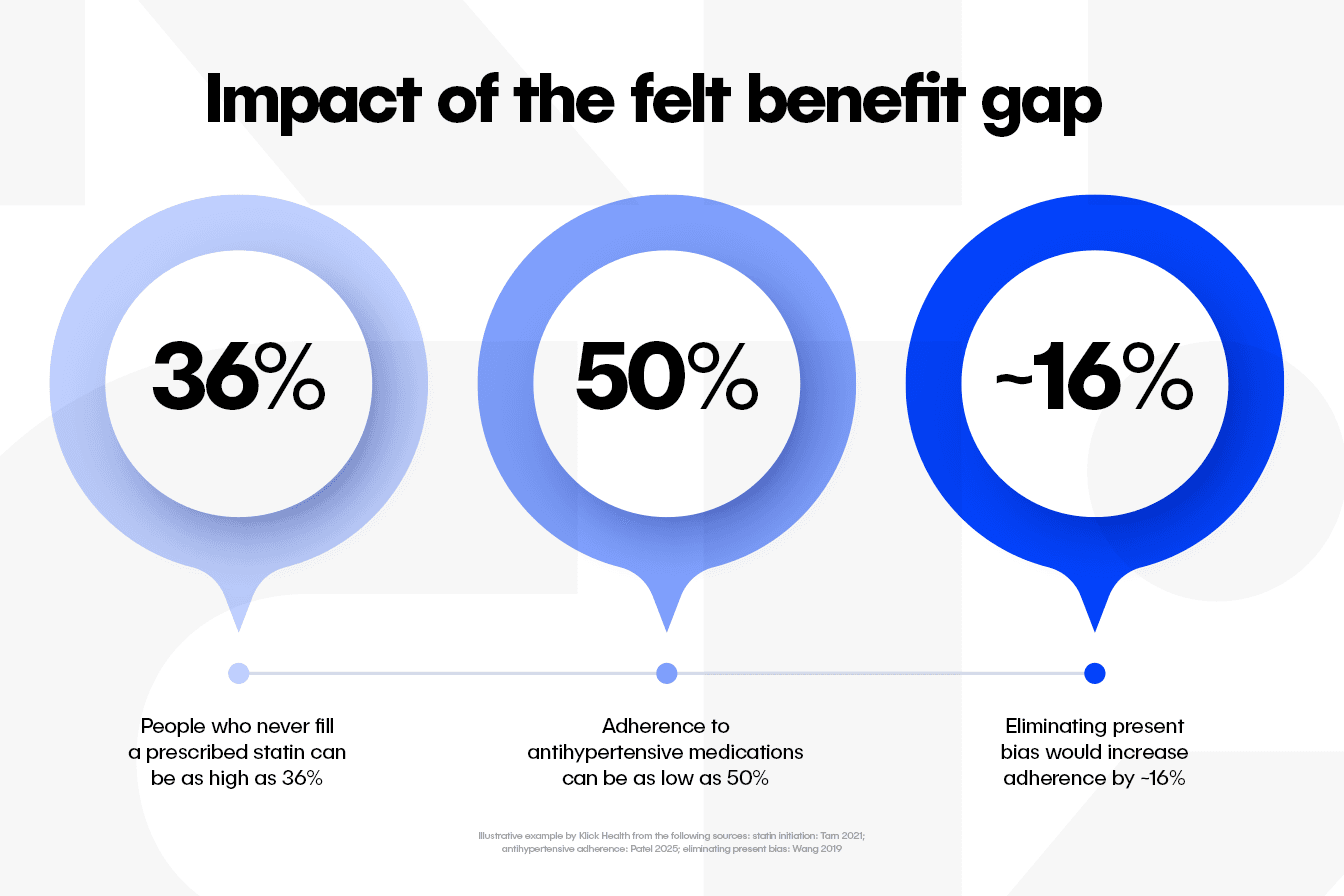
[References: statin initiation: Tarn 2021; antihypertensive adherence: Patel 2025; eliminating present bias: Wang 2019]
However, in some categories, the felt benefit gap is less pronounced. Oral contraception isn’t typically taken to relieve symptoms, yet many patients sustain use because the value proposition is immediate and personal. Taking the pill maps directly to feeling protected from an unwanted pregnancy, and the stakes are concrete rather than probabilistic.
Contraception offers a clear takeaway for marketers: when prevention feels personally meaningful and attributable to clinical intervention, protection becomes a felt reward that can sustain behavior over time.
Why the felt benefit gap is so corrosive to treatment initiation and persistence
Factors that contribute to the problem
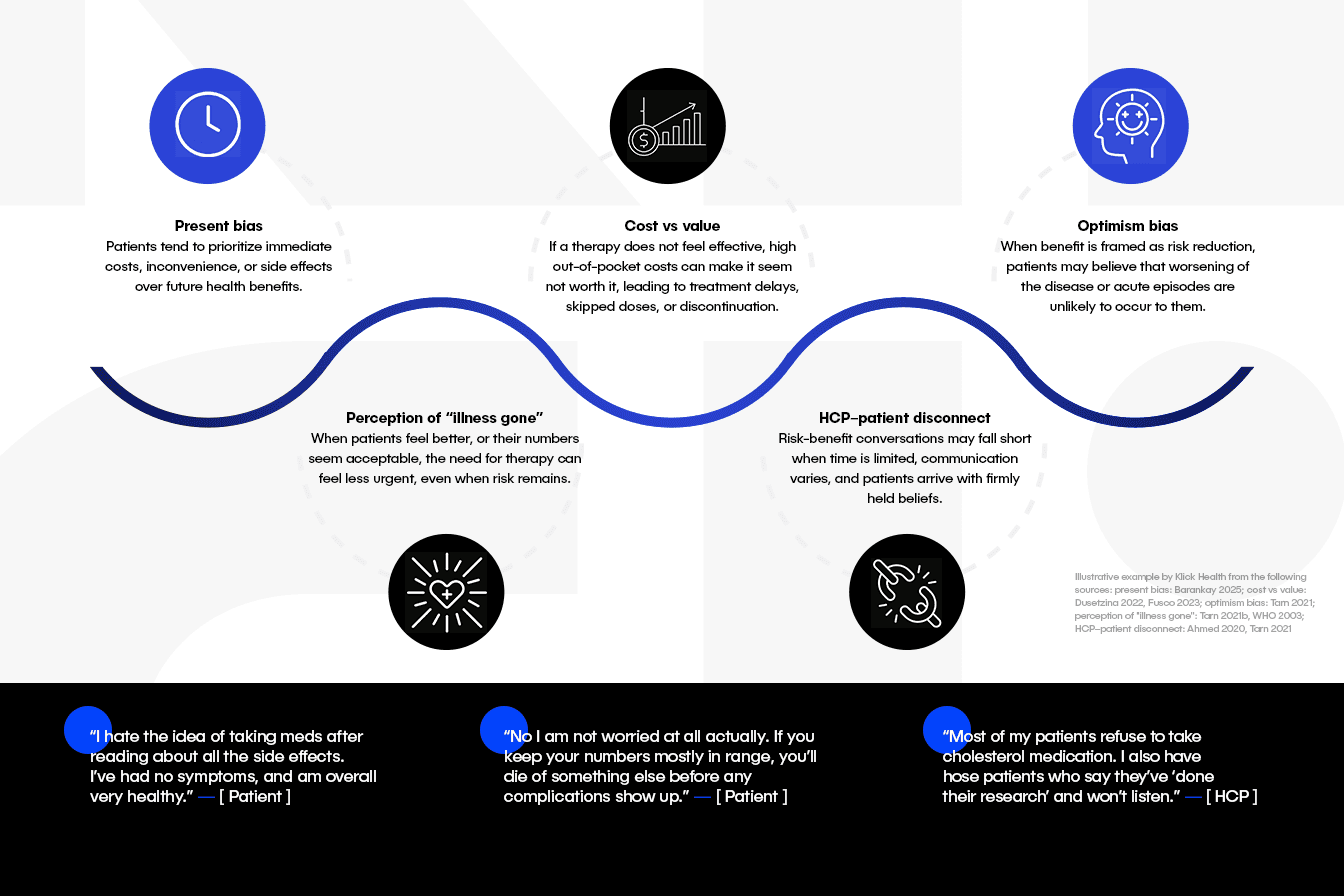
To bridge the felt benefit gap, marketers should prioritize these goals:
Make clinical benefits feel personally meaningful and attributable
Reinforce clinical benefits at the moments that drive persistence
Build advocacy through social proof, showing that “people like me do this,” with support from care teams and trusted communities

The Solve: Tactical Considerations
Reframing prevention into something patients can see, feel, and believe in requires a shift in how value is delivered and reinforced.
Turn “nothing happens” into an achievement: Identify where value disappears, then shift from risk to human meaning: what’s protected and what remains possible in a patient’s life. Tactics could include gamified reward systems anchored in meaningful outcomes rather than clinical endpoints.
Create tactics that serve as credible proxies for improvement: Deliver simple infographics and interactive visuals at key drop-off moments to build and maintain momentum. For example, an interactive patient tool could visualize disease activity and demonstrate how the therapy is working, even when symptoms were not correlated.
Build an aligned narrative: Develop a unified “felt benefit narrative” and carry it through the entire brand experience, from the office visit to direct patient engagement and support.
The goal is not only to control disease but to help patients recognize and believe in the protection they are gaining.
Interested in learning more about Klick’s approach to addressing the felt benefit gap? Contact us today.
Klick Health is the world’s largest independent commercialization partner for life sciences and a leading full-service pharma marketing partner, serving as agency of record for leading pharma, biotech, and healthcare brands. Klick’s specialized offerings are rooted in deep medical and scientific understanding, including market insights, award-winning creative, and proprietary AI and data models to craft impactful brand narratives and seamless customer journeys. Backed by nearly 250 medical experts and advanced healthcare analytics, Klick delivers integrated marketing strategy and communications, from new product launch strategy to MLR review with real-world evidence, helping brands thrive in today’s complex healthcare landscape. Learn more at Klick.com.
Authors

Andras Varadi
Medical Strategist

Dane Lund, PhD
Vice President, Medical Strategy

Jorge Durand, PhD
EVP, Medical Strategy



Ready to Drive Life Sciences Forward?
Experience the transformative power of Klick Health, where deep industry expertise meets cutting-edge AI-driven wisdom.
As your trusted partners in life sciences commercialization, we combine a storied history in healthcare with the latest technologies to elevate every facet of your omnichannel strategy. From crafting engaging narratives to enabling data-driven decision-making, our integrated capabilities ensure you lead the way in transforming patient outcomes through digital health innovation.
Let’s create something transformative together.