
Why Pharma’s Slower Influencer Model Is Its Superpower
Rethinking Influence: Signals, Systems, and Strategy
De autoria de Chiderah Sunny
What you’ll learn:
Pharma operates in a fundamentally different system that requires its own model, not a faster version of someone else’s.
The most effective form of influence in pharma moves away from reach and toward trust, favoring long-term ambassador relationships over campaign-based activations.
Regulatory constraints like MLR are the architecture that defines what credible, durable influence looks like in this space.
Pharma came to influencer marketing later than beauty or tech. The industry narrative frames this as a problem: pharma is behind, slower, less culturally fluent, perpetually catching up.
That framing is the problem.
It assumes that cross-industry benchmarks are the right goal. But when pharma tries to replicate a model designed for entirely different conditions, it doesn’t just underperform, it misallocates effort and investment.
Too many pharma marketers are attempting to operationalize a model that was never built for them. Pharma doesn’t have an execution gap; it has an opportunity to define a different model entirely.

Defining the Model
A model isn’t just a channel or platform. It’s the set of conditions that shape how influence is created, distributed, validated, and scaled, including incentives, infrastructure, governance, and speed of iteration.
The consumer brand model optimizes for speed: quick iteration, real-time engagement, frictionless publishing. Pharma operates within a different model entirely, one defined by regulation, validation, and accountability.
Pharma’s model behaves differently because its operating conditions are structured around necessary checkpoints. Those checkpoints do not just slow things down. They fundamentally reshape how influence works.

The Model We’re Measuring Against
When we talk about influencer marketing, we’re usually describing a model built for beauty and consumer brands, one defined by speed, cultural fluency, and low-friction participation.
In beauty, influencers move at the pace of culture. They respond to trends as they emerge, test products publicly, and translate brand messages into something personal and platform-native. They shape the creative themselves through filming, editing, posting, in real time, and adjust based on audience response.
Beauty brands are structured to support this: product seeding is fast, messaging is flexible. Creative boundaries are broad. If something resonates, creators build on it immediately, if it doesn’t, they pivot just as fast. The entire system platform behavior, brand process, and the creator workflow are aligned for visibility, responsiveness, and conversion. Influence here is built in public, refined through constant feedback, and scaled through repetition and optimization.
Pharma doesn’t operate under these conditions. It can’t rely on fast iteration, flexible messaging, or frictionless publishing. The operating environment is different from the start, which means the influence model must be different too.

MLR Is Part of the System, Not an Afterthought
In pharma, medical, legal, and regulatory (MLR) review isn’t a downstream checkpoint, it’s part of the operating system.
MLR determines what can be said, how quickly, and by whom. This doesn’t just alter execution, it reshapes the structure of influence itself. MLR does not limit influence but defines a more credible version of it. This is why direct comparisons to typical influencer models break down. Pharma content isn't slowed; instead, it’s governed by a different logic entirely: one of responsibility.

The Gap Isn’t a Failure: It’s a Structural Difference
What appears to be a gap is a difference in architecture. Typical influencer models prioritize speed and cultural immediacy; pharma prioritizes credibility and trust. These priorities produce different expressions of influence.
So the question is not how to catch up, but what does influence look like when it’s built within pharma’s constraints?
Rethinking Who and What an “Influencer/Influence” Is
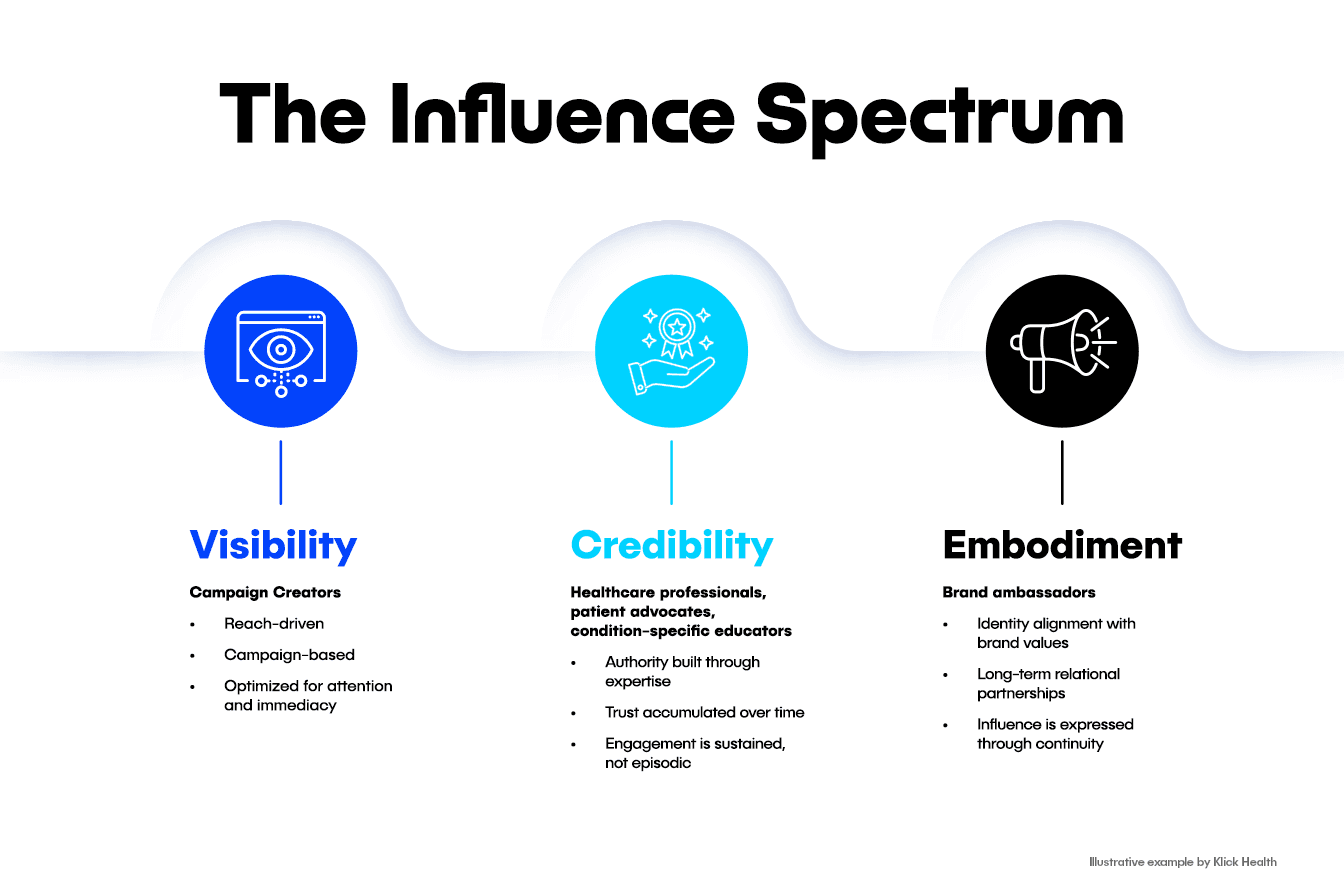
“Influencer” has become an umbrella term for anyone who can shape behavior. But influence does not operate in a single form, it exists on a spectrum.
At one end of the spectrum are campaign creators. This model is built on visibility: audience size, reach, virality, and shareability. Influence here is transactional, campaign-based, and designed to capture attention quickly.
But that is only one form of influence.
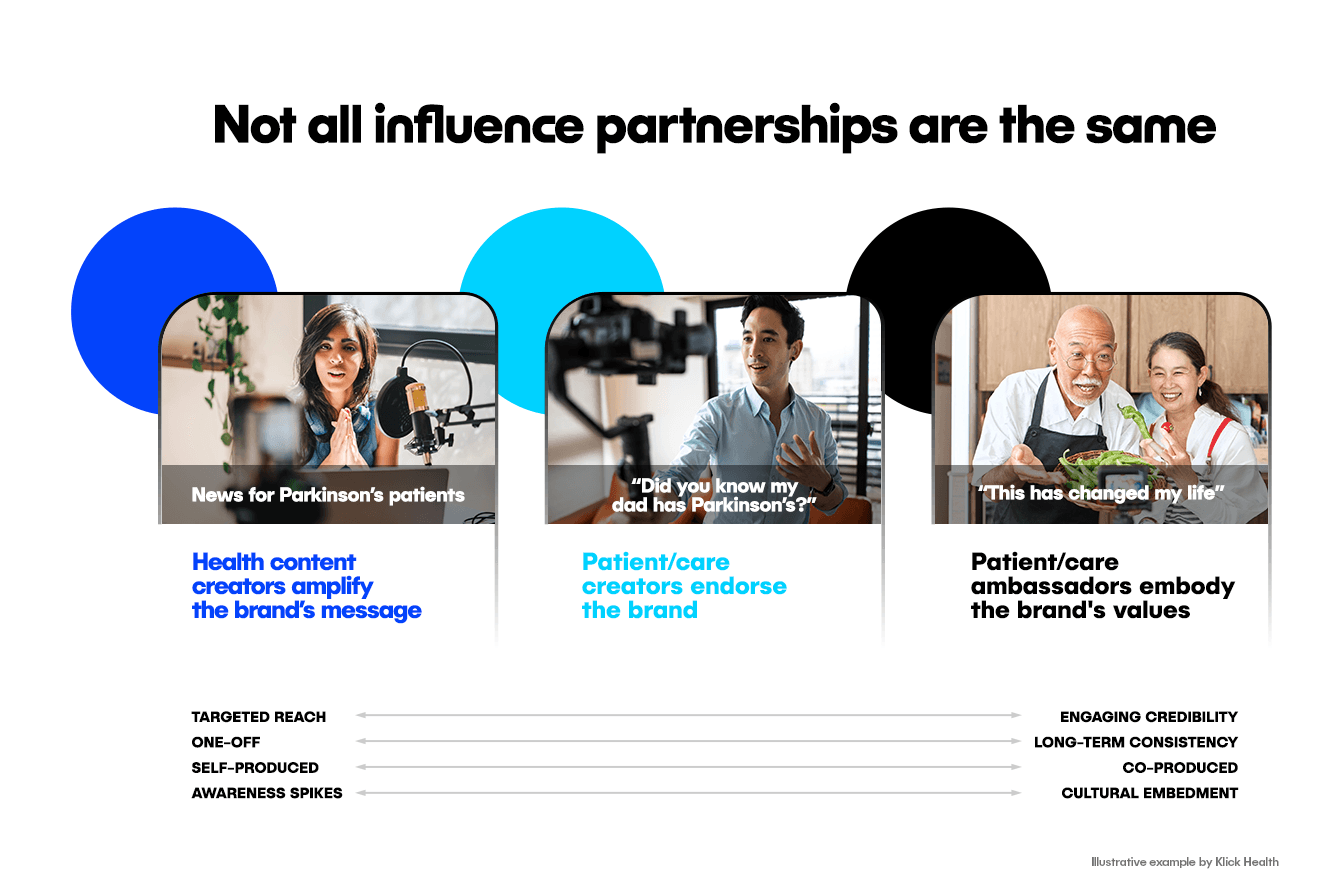
As you move across the spectrum from visibility to credibility to embodiment, the model changes. This is where pharma’s influencer opportunity lives.
Healthcare professionals, patient advocates, and community leaders carry a distinct form of authority rooted in trust, lived experience, and expertise built over time.
This creates the conditions for a different kind of partnership: brand ambassadorship. In this context, brand ambassadorship is not a one-off branded placement or testimonial. It is an ongoing, relationship-based model built on continuity, where creators or patient voices are engaged over time and help shape how the brand shows up across multiple touchpoints. This is not cosmetic participation, it is alignment.
Fitness and wellness brands like Gymshark already embrace this model. They recognize that influence is more durable when it’s embodied by individuals who genuinely reflect the brand’s values and their audiences’ lived realities.
Their ambassador programs are intentionally selective and built around holistic storytelling, not one-off moments. As a result, they don’t just participate in fitness conversations, they lead them while building deep, authentic connections with their audience.
The outcome: cultural resonance, sustained credibility, and deep community loyalty. Pharma already operates this way, just without consistently framing it as influencer marketing.
This spectrum can be understood visually:
How This Plays Out in Practice
This spectrum is best understood as a life cycle.
A patient advocate often begins by sharing lived experience and building trust within a community, independent of reach. As credibility grows, engagement begins, not because of audience size, but because of the depth and consistency of their voice.
The first formal relationship is usually transactional: a campaign-based partnership with defined messaging, approvals, and timelines. The creator’s job is to translate structured information into accessible content.
When alignment is strong, this evolves into repeat collaboration. The same voices get brought into multiple initiatives, early discussions, and feedback loops. Influence compounds through continuity, not isolated activations. This is where ambassadorship emerges.
At this stage, ambassadorship is a sustained relationship: the creator or patient voice is engaged consistently, playing an active role in shaping the brand’s influence rather than appearing only in episodic activations.
This is the progression from visibility to credibility to embodiment in practice.
In pharma, this framework is still emerging, not because it lacks relevance, but because we’re still designing the systems to support it from a social-first perspective. That’s the opportunity.
Ambassadorship isn’t a more efficient version of influencer marketing, it’s a different operating model, one built on accumulation, where cultural impact compounds rather than restarting with each activation.
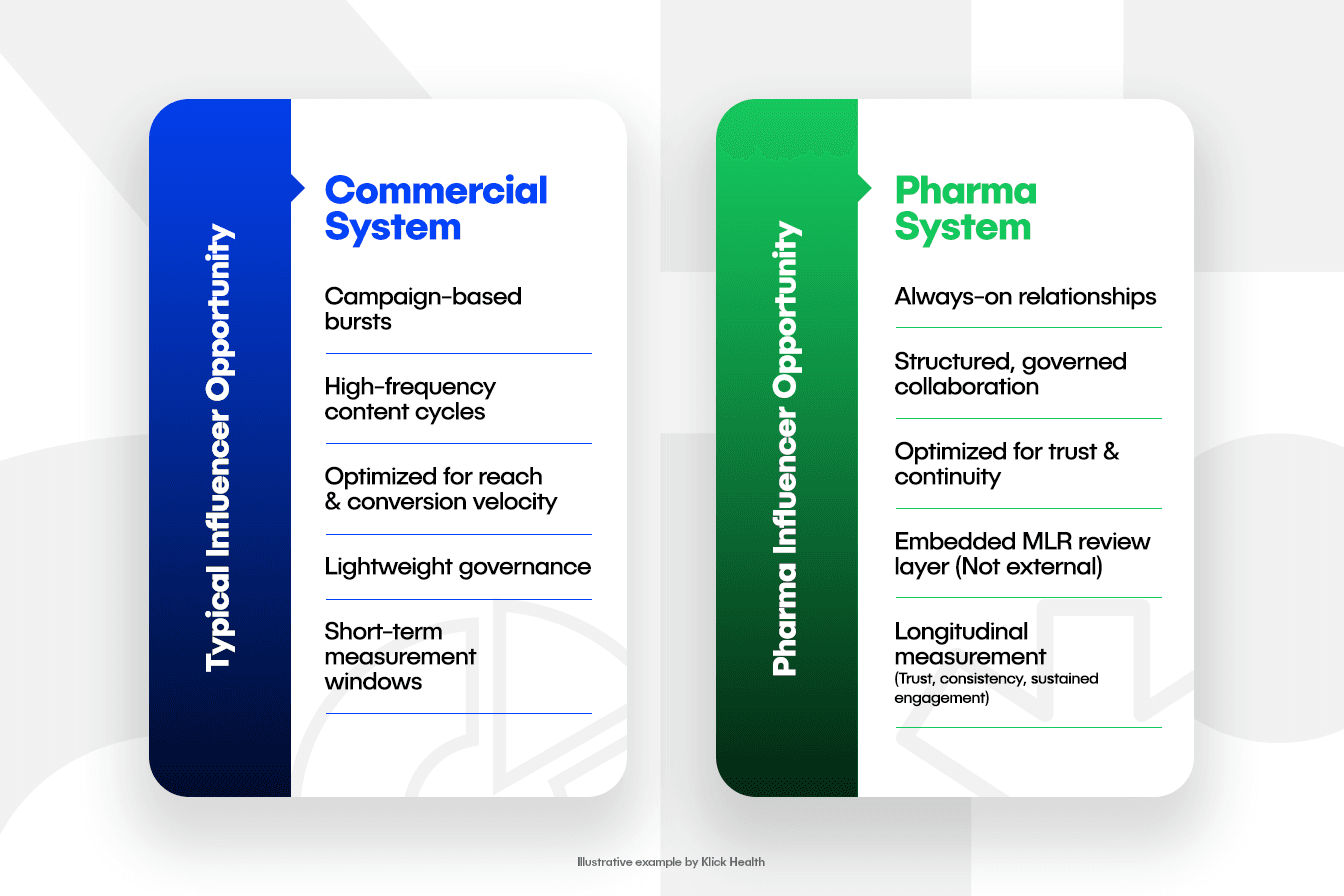
Typical Influencer Opportunity
Campaign-based bursts
High-frequency content cycles
Optimized for reach and conversion velocity
Lightweight governance
Short-term measurement windows
Pharma Influencer Opportunity
Always-on relationships
Structured, governed collaboration
Optimized for trust, continuity, and credibility
Embedded MLR review layer (not external)
Longitudinal measurement (trust, consistency, sustained engagement)
This is not a slower version of the same model, it is a different model entirely.
Redefining Pharma’s Model of Influence
The goal is not to replicate traditional influencer models but to define pharma’s own model of influence.
The absence of speed and frictionless publishing isn’t a disadvantage, it’s a structural reality that reshapes what matters. Credibility, continuity, and responsibility are not substitutes for speed, they are distinct strengths.
The question isn’t how to close the gap.
The gap is the model. It reframes the approach entirely. Pharma is not a delayed version of consumer influence, it is a different type of influence, one where trust is not a byproduct of reach, but the mechanism for reaching the right people.
Where This Leaves Us
Pharma isn’t starting from zero.
Relationships with patients, advocacy groups, and experts already exist. Stories are being told. Communities are engaged. Trust is already in motion.
Constraint doesn’t limit creativity, it sharpens it. It allows us to recalibrate expectations, redefine metrics, and build relationships designed to compound value over time.
If we embrace this continuity, it can become one cornerstone of influencer partnerships. We can build always-on collaborations that let influencers demonstrate they are credible, reliable figures in this space over time.
The question is no longer whether pharma has caught up, but whether it has set a new standard.
The Shift Starts Here
You don’t need to overhaul everything. You need a partner that recognizes what you already have and helps you lean into this model.
You likely already have existing partnerships that fit this model: patient advocates, HCPs with engaged followings, and community voices you’ve worked with more than once. They’re not slow, they’re underleveraged.
Here are three moves we can make right now:
1. Audit for continuity, not just reach We can look at your past two years of influence and advocate partnerships. Who have you engaged more than once? That repeated collaboration signals alignment of the raw material for ambassadorship. These are your starting points.
2. Shift from campaign briefs to relationship roadmaps We can identify your top five aligned voices, instead of asking, “What do we need them to say this quarter?”, we start by asking, “What role could they play across the next few months?” Here we map out touchpoints, not just content drops, but advisory input, early feedback on messaging, and community listening. This is how you design for accumulation.
3. Reframe your metrics Reach and impressions matter, but they’re trailing indicators of transactional influence. We should also track the signals for compounding influence: consistency of engagement over time, sentiment within condition-specific communities, partnership longevity, and depth of audience trust. We can help you develop a playbook that reflects the model you’re actually running.
These are the first steps toward realizing the pharma model.
Let's talk about what this looks like for your brand.
Klick Health is the world’s largest independent commercialization partner for life sciences and a leading full-service pharma marketing partner, serving as agency of record for leading pharma, biotech, and healthcare brands. Klick’s specialized offerings are rooted in deep medical and scientific understanding, including market insights, award-winning creative, and proprietary AI and data models to craft impactful brand narratives and seamless customer journeys. Backed by nearly 250 medical experts and advanced healthcare analytics, Klick delivers integrated marketing strategy and communications, from new product launch strategy to MLR review with real-world evidence, helping brands thrive in today’s complex healthcare landscape. Learn more at Klick.com.
Autor

Chiderah Sunny
Associate Director, Strategy
Conteúdo relacionado



Ready to Drive Life Sciences Forward?
Experience the transformative power of Klick Health, where deep industry expertise meets cutting-edge AI-driven wisdom.
As your trusted partners in life sciences commercialization, we combine a storied history in healthcare with the latest technologies to elevate every facet of your omnichannel strategy. From crafting engaging narratives to enabling data-driven decision-making, our integrated capabilities ensure you lead the way in transforming patient outcomes through digital health innovation.
Let’s create something transformative together.