
Global Brands, Local Truths
Why cultural fluency and intuition are now a strategic imperative
Authored by Bruna Rodriguez
What You Will Learn
Global Consistency vs. Local Relevance Why global consistency creates coherence, but only cultural relevance creates genuine understanding and connection.
Cultural Intelligence as Strategic Intelligence Strategic intuition is not the opposite of data; it is often the earliest signal of cultural truths that data has yet to reveal.
The Cost of Cultural Misalignment When brands are deployed without cultural understanding, the cost eventually appears as inefficiency, rework, and lost relevance.

The paradox of global brands
Global brands have never been stronger. Or more fragile.
They are built on strong positioning, unified platforms, and carefully defined brand systems designed to scale across markets. From a structural point of view, most global organizations have done the hard work.
And yet, many of these same brands struggle to feel relevant everywhere they operate. The very scale that gives them power also increases the risk of being misunderstood.
This is the central paradox of global branding today: the stronger the system, the greater the risk of cultural distance.
Consistency, once a competitive advantage, can become a blind spot when it is mistaken for sameness. For example, when a global brand uses the exact same message everywhere, assuming it will resonate equally across cultures, only to discover that what feels authentic in one market feels irrelevant or confusing in another. Even colors carry different meanings across cultures: while white is often associated with purity and weddings in Western markets, it is traditionally linked to mourning in parts of East Asia. Global brands that understand this distinction know that consistency comes from preserving meaning, not merely repeating the same visual execution everywhere.
In healthcare, especially, this is not a minor issue. Communication does not simply inform; it shapes trust, perception, and behavior. When brands miss the cultural context, they don’t just underperform. They slowly erode credibility.

When global logic meets local reality
Much of today’s global healthcare communication is influenced by U.S. models. There is no way this could be different. The big, rich, and direct-to-consumer market has a significant influence worldwide. Since direct-to-consumer communication is allowed and normalized, messages are explicit. Calls to action are clear. Brands speak directly to individuals and their needs.
But most markets do not operate under the same regulatory or cultural logic. In fact, only three countries worldwide allow direct-to-consumer communication in the pharma industry.
In many parts of the world, including Latin America, healthcare decisions are not individual acts. They are collective processes shaped by family dynamics, social influence, religion, education, public system, and cultural norms. Meaning is built through relationships, familiarity, access, and shared understanding, not just clarity of information and a call to action. While HCPs are part of the decision-making process, they are not the only factor that individuals consider when filling a prescription or purchasing an over-the-counter medication.
When global brands apply the same communication logic everywhere, they often interpret a lack of response as resistance. More often, it is misalignment.
What is often labeled a “local execution problem” is, in reality, a strategic misunderstanding of culture. Framing it as a "casting issue," as if swapping one actor for another who looks more local is enough, is that same misunderstanding in disguise.

What culture explains and brands often overlook
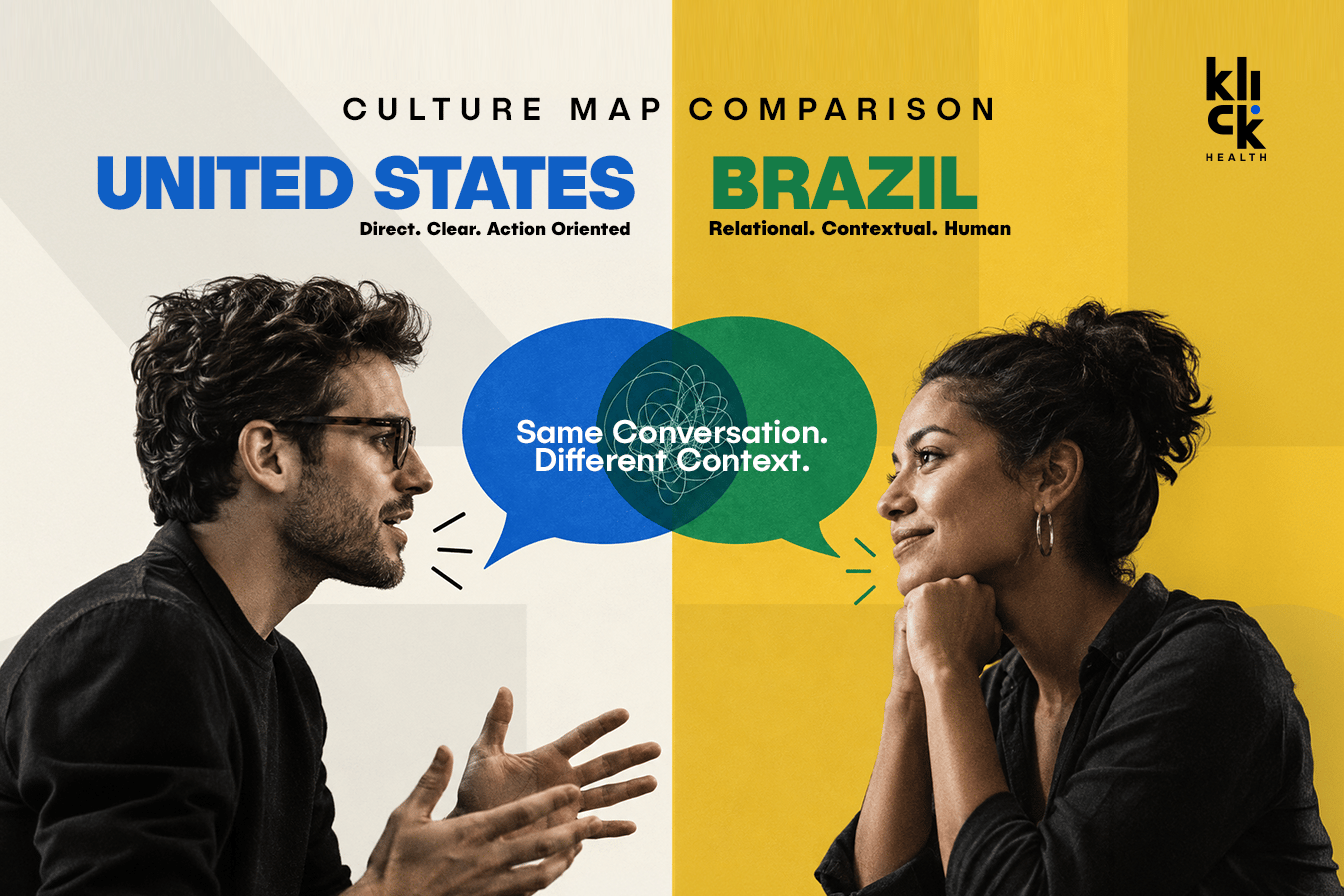
In her 2014 book The Culture Map, Erin Meyer offers a useful lens for understanding why well-intentioned global communication so often misses the mark.
She introduces a framework that shows cultures differ not only in language but in how meaning itself is constructed. Among the most relevant dimensions are:
Communication context: In low-context cultures, meaning is explicit and verbalized. In high-context cultures, meaning lives between the lines.
Trust-building: Some cultures build trust through task and expertise, others through relationships and shared experiences.
Persuasion: Logic-based arguments resonate in some markets, storytelling and social proof matter more in others.
While these dimensions shape personal interactions, they also help us understand how brands are perceived in a local market. They can help us understand areas of alignment but also the sources of misunderstanding.
1. Communicating
United States leans toward low-context communication:
Messages are explicit, direct, and clear.
Saying exactly what you mean is valued.
Clarity is prioritized over nuance.
Brazil leans toward higher-context communication:
Meaning is often conveyed through tone, relationships, and context.
People may avoid being overly direct to preserve harmony.
Reading between the lines is more common.
2. Evaluating (Giving Feedback)
United States tends to give feedback directly, but diplomatically:
Positive feedback is frequent.
Critical feedback is often softened with positive comments and specific suggestions.
Brazil tends to give feedback more indirectly:
Maintaining good relationships is a priority.
Negative feedback is often delivered privately and with greater sensitivity.
3. Persuading
United States is generally applications-first:
Prefers practical examples, data, and actionable recommendations.
Focuses on business impact and outcomes.
Brazil leans more toward principles-first:
Values understanding the broader context and rationale.
Relationships and the “why” behind a decision often come before execution.
4. Leading
United States is relatively egalitarian:
Leaders are approachable.
Employees are encouraged to challenge ideas and contribute regardless of title.
Hierarchy exists but is relatively informal.
Brazil tends to be more hierarchical:
Leadership carries greater authority.
Seniority and titles are generally more respected.
Teams often expect leaders to provide direction.
5. Deciding
United States tends to make decisions relatively quickly:
Teams discuss options openly.
Once alignment is reached, execution moves fast.
Brazil tends to involve more consultation with key stakeholders:
Decisions often require broader alignment.
Personal conversations outside formal meetings can play an important role before a final decision.
6. Trusting
United States is primarily task-based:
Trust develops through competence, reliability, and delivering results.
Business relationships can begin quickly.
Brazil is strongly relationship-based:
Personal connections are essential.
Investing time in getting to know people builds trust before business.
7. Disagreeing
United States is relatively comfortable with open disagreement:
Challenging ideas is viewed as healthy discussion.
Debate is usually separated from personal relationships.
Brazil tends to avoid direct confrontation:
Preserving relationships and harmony is important.
Disagreement is often expressed more diplomatically or in private.
8. Scheduling
United States leans toward linear-time scheduling:
Agendas, deadlines, and punctuality are highly valued.
Plans are expected to be followed closely.
Brazil leans toward a more flexible approach to time:
Relationships and changing priorities can influence schedules.
Adaptability is often valued over strict adherence to plans.
Key Takeaway
United States: Direct • Fast • Task-oriented • Egalitarian • Structured
Brazil: Relationship-driven • Contextual • Flexible • Hierarchical • Collaborative
The critical insight is this: what feels neutral, clear, or empowering in one culture may feel cold, simplistic, or even dismissive in another.
Living in different cultures helps explain why. Countries differ not only in how they communicate, but also in how they build trust, persuade others, and make decisions. Many LATAM markets, for example, tend to be more relationship-based than countries such as the United States or Germany. Trust is often established through personal connection and credibility before it is extended to institutions, brands, or expertise. As a result, a message that relies purely on facts, efficiency, or rational argument may feel compelling in one market but insufficient in another, where context, emotion, and human connection play a greater role in persuasion.
Of course, LATAM is not a single cultural block. Argentina, Brazil, Mexico, and Colombia each occupy different positions across Meyer’s dimensions, and treating the region as culturally homogeneous can be just as risky as assuming that a global campaign will resonate everywhere. The goal is not to create a hierarchy of countries or endlessly localize every execution. Rather, it is to understand where meaningful cultural differences exist and adapt the brand's expression accordingly, while preserving the strategic idea at its core.
For brands, this means cultural misunderstandings rarely look like failure at first. Campaigns launch. Assets run. Metrics move slightly.
But resonance is missing.
And without resonance, trust does not deepen.

Beyond frameworks: intuition as strategic intelligence
Frameworks help global teams make sense of cultural differences. But they do not replace something equally critical: strategic intuition.
In complex cultural environments, not everything that matters is immediately measurable. The most important insights often appear first as signals—tensions, discomfort, or a subtle feeling that something is not landing as intended. Strategic intuition is not guesswork but pattern recognition built through experience, cultural proximity, and immersion. It allows leaders and teams to sense when a strategy is technically right, but culturally wrong.
In global organizations, this intuition often lives in local teams. When ignored, it is dismissed as opinion. When it is valued, it becomes early strategic intelligence and often the difference between brands that adapt late and those that lead early.
The cost of ignoring local strategic intuition is real. Many organizations treat local insight as something to involve later, or to optimize away. But ignoring cultural context does not reduce cost. It leads to underperforming campaigns, repeated revisions, and strategies that look right on paper but fail to move behavior.
Cultural fluency is often discussed as a creative concern. In reality, it is a strategic one.
Building Adaptive Brand Systems for Evolving Asia
Read Now
Argentina and the strategic power of cultural fluency
Our work on a global brand in Argentina is instructive not only as a creative showcase but also as a strategic demonstration of cultural fluency. We used local insights to align with the larger campaign promise and connected successfully with our intended audience.
The Argentina activation was developed entirely within a global masterbrand framework. The science remained intact. The brand promise did not change. Strategic integrity was preserved.
What changed was the cultural entry point.
The work began with a simple, specifically local insight: in Argentina, there is a shared social behavior around postponement, justification, and delay, captured in a single word: chamuyo.
Chamuyo is the art of talking your way out of something. A culturally recognized way of explaining why “now” becomes “later.” It is humorous, human, and immediately recognizable.
Rather than confronting people with more information or urgency, the campaign reflected this behavior back to them. It acknowledged the excuses people tell themselves with empathy and cultural honesty.
This insight mattered because the problem was not a lack of awareness. Intention existed.
However, the barrier was behavioral.
By speaking in a culturally fluent way, the brand shifted from instruction to recognition. From persuasion to identification.
That is not an adaptation.
That is strategic fluency in Argentina.

A provocation for global leaders
Look at the brands you lead, build, or support.
Are they truly understood everywhere they operate?
Or are they simply deployed everywhere?
How early are local teams involved in shaping strategy, not just executing it?
And how much value is being lost by ignoring intuition that could have prevented misalignment from the start?
Global vision will always matter.
But without local intelligence, it is incomplete.
The future of global brands will belong to those who understand that consistency and cultural fluency are not opposing forces.
About Klick LATAM
Klick Health focuses exclusively on marketing and communication solutions for life sciences. No bolted-on healthcare divisions. No competing business models. Our ecosystem integrates strategic consulting, medical and scientific services, omnichannel marketing, and digital innovation to deliver measurable results across Brazil and other Portuguese- and Spanish-speaking markets. With a track record of award-winning creativity, we bring a local perspective to every piece of work we touch.
Learn more at klick.com/LATAM.
Klick Health is the world’s largest independent commercialization partner for life sciences and a leading full-service pharma marketing partner, serving as agency of record for leading pharma, biotech, and healthcare brands. Klick’s specialized offerings are rooted in deep medical and scientific understanding, including market insights, award-winning creative, and proprietary AI and data models to craft impactful brand narratives and seamless customer journeys. Backed by nearly 250 medical experts and advanced healthcare analytics, Klick delivers integrated marketing strategy and communications, from new product launch strategy to MLR review with real-world evidence, helping brands thrive in today’s complex healthcare landscape. Learn more at Klick.com.
Author

Bruna Rodriguez
Vice President, Strategy III


Ready to Drive Life Sciences Forward?
Experience the transformative power of Klick Health, where deep industry expertise meets cutting-edge AI-driven wisdom.
As your trusted partners in life sciences commercialization, we combine a storied history in healthcare with the latest technologies to elevate every facet of your omnichannel strategy. From crafting engaging narratives to enabling data-driven decision-making, our integrated capabilities ensure you lead the way in transforming patient outcomes through digital health innovation.
Let’s create something transformative together.